Jade Rodgers

Free the Archives | This project began with the intent to analyze the black family model in contemporary society. Black families throughout history have been broken and torn due to the effects of slavery, and more presently the stereotypes that surround what the black family model looks like. Following the present-day relationships of my own family members, I aim to highlight the importance of a running documentation of the family archive. Archives, which can be used to keep families closer and give access to the past on a deeper level.

This work is meant to analyze and reinvent the ways in which we look at the black family. In the past, documents like “The Willie Lynch letter” gave step-by-step instructions on how to deconstruct the black family, and make slaves out of them. In this history, we can examine the ways the black family began to crumble, how the separation of family led to the loss of what it means to be Black in America. These ideas were shared through generations orally and internalized. Using images of my own family to examine how these histories have in fact affected their being and the ways in which my family exists individually and as a unit. www.jadethesage.com

Barbara Diener

The Rocket's Red Glare | The Rocket's Red Glare follows in the footsteps of two instrumental rocket scientists. Teenagers in the 1920s, a time in which rocket science and space exploration were confined to science fiction novels, Wernher von Braun in Germany and Jack Parsons in Pasadena, CA were part of their respective rocket clubs. They talked on the phone for hours about their home-grown explosions and rocket fuel tests. One went on to develop the V2 rocket for Hitler and the Saturn V for NASA. The other made groundbreaking contributions to the development of rocket fuel but was also second in command of Aleister Crowley’s occult religion, Ordo Templi Orientis, and was written out of NASA’s history for decades.

In 1932 Wernher von Braun went to work for the German army, which fell under National Socialist rule the following year. Accounts of when he joined the NAZI party vary but by 1937 he was the technical director of the Army Rocket Center in Peenemünde where the V2 rocket (Vengeance Weapon 2) was created and tested. After the war, when von Braun was brought to the U.S. under the controversial Operation Paperclip, a government initiative to secure and extract German scientists, his talents were called upon by the U.S. military. He settled in Huntsville, AL with members of his original rocket team where they eventually developed the Saturn V and put the first man on the moon.

Jack Parsons was born and raised on Orange Grove Boulevard, also known as Millionaire’s Row, in Pasadena, CA. Although he never attended CalTech he spearheaded the self-proclaimed “Suicide Squad”, a group of CalTech students, who shared Parsons love for rocketry. In 1936 these founders of what would become the Jet Propulsion Laboratory conducted the first rocket tests in the Arroyo Seco, and were soon after commissioned by the U.S. Army Air Corps to develop “jet-assisted take-off” rockets. In the subsequent years Parsons became more and more involved with the Los Angeles chapter of the Ordo Templi Orientis and he opened up his home, the Parsonage, to an eclectic cast of characters. In 1942 Parsons co-founded the rocket and missile manufacturer Aerojet but by 1944 he was bought out and his affiliations with military and government projects were terminated. Parsons died tragically from fatal injuries after a presumed accidental explosion in his home laboratory.

To weave together a sense of these two complicated stories, I have photographed places of significance, made portraits referencing existing images, and appropriated archival material. Many of the titles for my photographs are taken from an untitled poem written by Parsons. Rather than presenting a complete view of this history, I am posing questions, looking at the way that history is passed on through generations, and how facts are distorted, embellished, or undermined. www.barbaradienerphotography.com

Ioanna Sakellaraki

The Truth is in the Soil | After my father passed away three years ago, I returned to my homeland Greece and followed my mother’s behaviors as a believer seeking for shelter in the wider system of religious traditions and cultural beliefs in a society functioning on that basis.

Photography transformed itself into a question of becoming through loss and made the passageway within a liminal space of absence and presence. As the project advanced and while inspired by the origins of ancient Greek laments, I dwelled within traditional communities of the last female professional mourners inhabiting the Mani peninsula of Greece looking for traces of bereavement and grief.

My personal intention for realizing this project has been the impossible mourning of my father that is yet to come while making this body of work that contemplates around fabrications of grief in my culture and family. In a way, these images work as vehicles to mourn perished ideals of vitality, prosperity and belonging. By connecting my poignant grief with the dramatisations performed by the professional mourners, I look into the subjective spirituality of Greek death rituals.

I am interested in how the image affirms things in their disappearance and gives us the power to use things in their absence through fiction. The photographs themselves lay between real and unreal allowing the viewer to believe in the real that is yet to come; another type of reality. ioannasakellaraki.com

Mallory Trecaso

Restorative | The series of photographs in Restorative examines intimate views of home interiors that metaphorically embody my physical self. Emergency surgery left me with new marks, scars, and a patchwork of temporary solutions, and a heightened understanding of my own physicality. I use the familiar subject of the home to talk about my body. Looking through the lens of the home as a metaphor gives the viewer a different framework to view, rather confronting one’s self directly. Like a home, a body records time through markings, imperfections, discoloration, and cracks. Some, like a broken window or a scratch, happen suddenly while others take an extended period to fully manifest on the surface, such as cracks in the structure or human scars.

For the last six years, I have battled Crohn’s, an inflammatory bowel disease. I underwent emergency surgery that I thought would lead to a quick recovery but I emerged from the operating room with an ileostomy, something that saved my life but drastically altered my physical state. The process left me with scars, markings, and tentative solutions both large and small that are constant reminders of the invasion and trauma of surgery.

I find moments in the home that are a record of time, alluding to my lived experience. The body referenced in the photographs is my own, one that is in a restorative process. Imperfections within the houses I photograph symbolize my own physical state. For example, the large crack held together with transparent tape and centered in the frame of Incision breaks the continuous pattern of wallpaper, suggest the discolored scar left on my abdomen. I photograph these moments within the home at the same distance referencing how the distance does not change when looking at my own body.

Both the house and the body are intimate as well as social spaces. The body is a private, personal space but when in contact with another person moves to a social space. Similarly, the home is a private space that one inhabits with some degree of security but when others are invited in, it becomes a social space for interaction. Through my photographs, I metaphorically address private and social space.

Through a repeated vertical orientation, I create a sense of order, structure, and perseverance. The vertical orientation suggests the upright figure, still standing after a physical struggle. Finding order and structure when photographing produces a sense of control that my own body lacks due to my autoimmune disease. Using light and shadow to call attention to the physical imperfections within the home, I create a sequence that references my own state of mind through my journey with Crohn’s disease. Darker images reference time filled with depression, fear, and uncertainty while the brighter images suggest moments that, in retrospect, were pivotal in accepting and coping with Crohn’s.

In making these photographs, I took a deeper look at myself and came to understand that my body is in a restorative state, similar to homes I photograph. I invite viewers to think about their own marks from lived experiences and understand that their imperfections are a record of time. My thesis presents my personal timeline through Crohn’s disease but also opens a more universal conversation about discovering and processing trauma. www.mallorytrecaso.com

Dylan Everett

The preface to Oscar Wilde’s The Picture of Dorian Gray | The preface to Oscar Wilde’s The Picture of Dorian Gray is a series of aphorisms about art and beauty, including the declaration that “all art is at once surface and symbol.”

If all art is at once surface and symbol, I create symbolic surfaces. Through the use of photo-collage and still life, my pictures collapse figure and ground into surface. Drawing from a range of references – my personal life, literature, art, pop culture – and cultural signifiers, these surfaces are loaded with symbols. The viewer is invited to decode these symbols, or at least to try.

The symbols in my images often function as homages to the people and things that I love or admire: LGBTQ-identified creative figures, gay icons, and personal relationships. In one instance, this manifests as a room constructed of cyanotypes inspired by John Dugdale; in another, a grisaille room winks to George Platt Lynes’ black-and-white male nudes that remained hidden until after his death. This series of homages is held together by an aesthetic that strips away any sense of hierarchy among cultural signifiers. In my fabricated spaces, there is no distinction between highbrow and lowbrow, personal or famous, historical or contemporary. www.dylaneverett.format.com

Luca Iovino

I wrote “città nuova” in 2014, as an attempt to describe the feeling of Drifting, the filter I used to codify the city. I wanted to translate, in my own words, the feeling of loss and rediscovery I perceived through that combination. Years later, while reading those words I wrote, I felt the need to start working on a project that would enable me to give shape to the intangible nature of that thought, by creating a space poised between places that were both real and imaginary. I wanted to create a city to regain my sense of abandonment, a city where the mapping of a place becomes the tool to perceive a reality filtered through sheer invention. The city should not be viewed as we know it, but dismantled of its archetype, with new detailed foundations rebuilt from its ashes.Now that the city has lost its pivotal role, my point of view becomes the bearer of a new meaning, through the innate need to give all things their own shape: statues, maps, objects, the flexible shape of the human body, the man-made form of the landscape.

Kearston Hawkins-Johnson

As an actor, I'm trained to explore the messy, vulnerable parts of humanity and showcase it to others. Outside of showcasing a character on stage or film, I imagine what I call, "the moment before" of the character.

I'm very curious as to what happens behind the scenes. Before the stage lights come on, before realizing there's a camera in your face, before the thoughts of socialization and perfection creep in. The authenticity that exist before a performance.

Time is fleeting, existentialism reigns, and I'm just fascinated by the construct of people, places, and things in this moment in time. I enjoy documenting the shadows that exist, the moments before, the day to day in their natural essence. It is itself a performance. www.kearstonhawkinsjohnson.com

Stephen Goldstein

Approaching Garland | Approaching Garland is a project about small communities off the grid, scattered around the outskirts of Flagstaff, Arizona. People who live in a rural setting, some that live off the land, and settled in the mountains of Northern Arizona. The work revolves around a significant forest road in Parks, Arizona, called "Garland Prairie". 

Dominik Wojciechowski

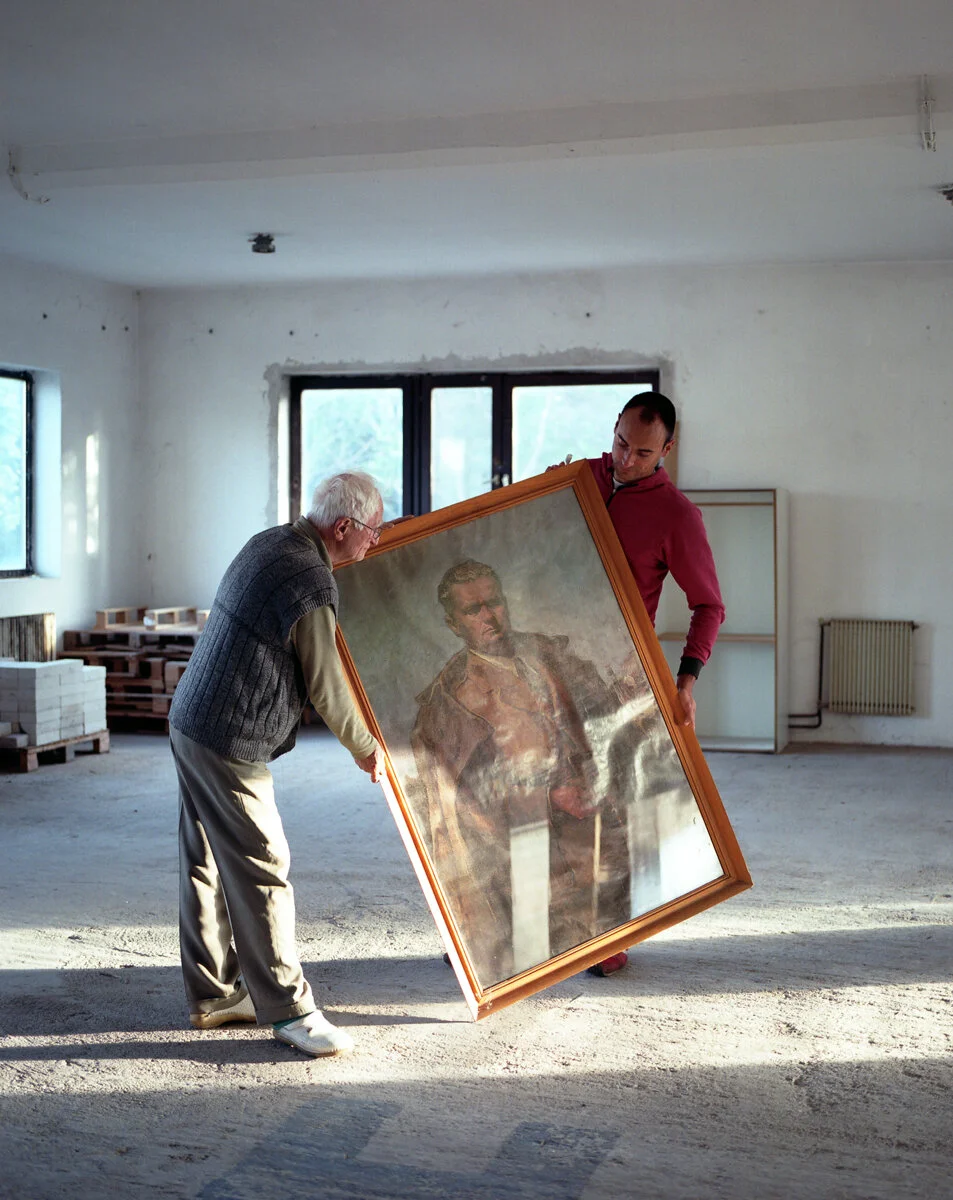
Svijet | Since the Break up of the socialist Yugoslavia, expansion of nationalisms which leaded to bloody conflicts, inhabitants of the nonexistent country of Tito, are trying laboriously to build new identities. For some, it could be a national identity, strong identification with an ethnic group. Others, might not accept multi-national reality, preserving the myth of Yugoslavia caused by feeling of loss. Loss of the once great country, that coexisted happily despite many cultures. The second group is represented by the elders who were growing up in Tito’s country but their stable life was disturbed by war. They are now, living in these seperate,small countries that emerged from balkan humanitarian disaster. What keeps them alive is yugonostalgia, which is a common factor among the old generation. The other group includes people, not entirely sure of what their identity is. They are being recruited from the generation that was born during Balkan Wars or right after it and they have passed on their confusion to their kids.

While travelling around Former Yugoslavia, through the countries that are not so similar anymore, sometimes even treating each other like enemies, it is difficult not to see the common factor between these countries. Something far more deep than their shared history. It is the post-yugoslav identity and mentality that appears on different levels – both in private and collective stories. It shows up in daily decisions, in political, social, cultural life as well as collective imagination. In opposition to yugonostalgia, which is emotionally pointed to the past, post-yugoslav identity is a daily practice. It is born inbetween yesterday and today, between historically rich past and the still evolving present.

Macaulay Lerman

Greer Road | Of all the symptoms of youth, perhaps the greatest is the inability to see beyond the world that currently is. The intoxicating illusion of permanence that defines the early years of our lives is proven false by the transient nature of young adulthood and slowly we begin to see existence for what it is; an endless process of becoming.

For as long as I can remember I have not wanted to live in this world. When I was a child this feeling manifested itself in the form of endless hours spent reading The Lord of the Rings and gallivanting off on epic quests of my own in the woods behind my family’s home. When I was a teenager the feeling remained, and yet the expression of it shifted. I discovered anarchist rhetoric, befriended local squatters, and began traveling in slowly expanding circles away from New England via hitchhiking and freight train. I tattooed my face and hands with a sewing needle and India ink, drank wine from a bag, and slept out in the woods with others who had chosen the same path.

This is how I met Nate. I picked him up along with a mutual friend at an Occupy encampment in Lancaster PA in 2011, and together we circled the country in a $500 van I had purchased from an Alpaca farmer the week before. We busked for our money, ate out of grocery store dumpsters, and for a few years at least successfully evaded time.

I imagined we’d live this way forever. That our bodies would never betray us and that the excess of society would always be enough to scrape by. However, as we entered into our early twenties an increasing plague of heroin addiction and subsequent death spread rampantly throughout our community. Our days no longer existed in a weightless suspension, change was coming.

Nate took a job on a fishing boat in coastal Alaska, and I moved to Vermont to attend a small liberal arts college. In the Summer of 2016, Nate lost his pinky in an accident while out on a 3-month fishing contract. To avoid a lawsuit he was offered a large cash settlement in addition to his pay for the 3-month voyage. With nearly $100,000 in hand, Nate bought 5 acres of land in Fritz Creek AK and began building

a small homestead. Through word of mouth, this story spread throughout the nomadic punk community and soon others came to Fritz Creek with similar pursuits in mind.

If there is a common thread between travelers of this nature, it is the disbelief that you could ever truly belong in this world. That there is nowhere for you to go and so you must learn to live between things. This is simply not true. There is a place amidst the white spruce and Pacific yew where in the summer months the alpenglow suspends and it is always almost morning. There is a place past the spit up on Greer Road where the paved road ends and the fireweed takes root; thriving, becoming. www.macaulaylerman.com

Lake Roberson Newton

Flowers For the Dead | Flowers For the Dead is an ongoing project that examines historical sites, homes and institutions in the United States that are open to the public. Acting on William Faulkner’s quote ‘The past is never dead. It’s not even past’, I undertook a project where ‘real life’, past or present, should be made to seem real- for it is not believable solely for the fact that it happened.

This idea is manifest in my interest in how once private or historically important homes have been preserved for current public consumption, the roll objects and spaces play in presenting a particular history and its context to greater social narratives, how physical alterations to original places project themselves experientially, and the effect the public plays on defining the engagement of a preserved space. For me, the process provides insight and understanding- for what could be more pitiful than a voyeur in the dark. www.lakenewton.com

Siew Png Sim

Longing for Belonging | My work seeks to capture the pursuit of solace in the spaces that I reside. It’s a therapeutic exploration of my personal fleeting relationship with the concept and definition of a physical home. From a young age, my family and I constantly moved around various cities never settling down for long periods of time. I was enrolled to international schools, where it was a norm to see a constant change in classmates and teachers.

Detachment from the sentimental links that makes up the common notion of home eventually became habitual. Only upon returning to my home country of Singapore for my mandatory military service, I realised how “rootless” I was; and how that affected my ability to re assimilate with the home country I’m suppose to serve.

Most of the photos are unplanned and are taken during day to day life. They have a view of a distant observer, searching for the warmth of belonging in unfamiliar environments. www.siewpngsim.com

Leia Ankers

Airsoft Wankers | Airsoft originated in Japan during the mid-1970s, mainly because it was illegal to own firearms by private individuals. The shooting sport Airsoft involves two teams, red and blue. Both of these teams use airsoft guns to eliminate their opponents by hitting each player with spherical non-metallic pellets.

A pellet does not mark its target and so it relies on an honor system as part of the role play game. When a player is hit, the person is expected to call themselves out even if no one witnessed the hit. To re-spawn they must touch the building of the marshals choosing.

Between the hours of 1000 to 1600, these young men are in the mindset of soldiers, their surroundings and their use of the environment gives them the impression of war and anyone wearing the opposite tape to them is their enemy. The series projects the traditional traits of male identity combined with symbolic landscapes. www.leiaankers.com

Seth Johnson

I’m Still Here | My brother has lived in the same small town and has worked the same job for thirty years. It’s a town that is content with its own adequacy and looks at anything beyond with an air of suspicion. If there is a whisper of change, it rarely takes hold. This way of existing does not question itself, and I find this simplicity both foreign and endearing. While I have often envied my brother’s contentment with the small and sweet narrowness of our home- town, I wrestle with the idea that I want more for him than he wants for himself. www.sethjohnsonphoto.com

William Castellana

South Williamsburg Brooklyn | Street photography, in terms of the “unposed,” is a practice that serves the compelling need to distill the ebb and flow of visually complex interactions into static form - forever fixed and with meaning. It is this desire to understand more deeply the rhythms of humanity that takes me to the streets in search of clarity.

In their simplest sense, the images in this series form a social document of a people and a place; namely, a sect of Hasidic Jews known as the Satmars. This sect of Hasidic Jews was founded in Satu Mare, Romania by Rabbi Joel Teitelbaum in the early 20th century. After WWII, Teitelbaum settled in

Williamsburg, Brooklyn to lay the groundwork for a religious ideology that would launch one of the largest Hasidic movements in the world. Since Teitelbaum’s death, the Satmar community has grown exponentially and continues to thrive economically and spiritually through closely observed traditions and social mechanisms.

Between the fall of 2013 and 2014, I set out to photograph my neighbors in the one-half square mile area below Division Avenue, which demarcates the religious from the secular communities of Williamsburg, Brooklyn. The photographs in this book are constrained to the “neighborhood view,” since my outsider status made access to a more privileged look impossible.

As an outsider, what I witnessed through my camera during that period was forever new and unique compared to my everyday routine and what the rest of the city’s inhabitants were pulsing to. For me, street photography is about the preservation of time and place - a kind of poetry that distills both in equal measure. www.williamcastellana.net

Yulya Pavlova

Seek And Hide | When I began to work on this project my aim was to show famous stereotypes in the raising of children. I asked my son to help me with visualization. I’ve made pictures about such statements as «Boys don’t cry», «Boys must be strong», «Children must grow in greenhouse conditions», «A child is the main person in the family», «Child has to have tough borders» and etc...

But suddenly my son refused to be photographed. He said that it is not interesting to him and became angry. I noticed some «signs» that he showed me, such as the angry or sad face or he could run away from me. What's the matter with him? I tried to understand.

After that, my son began to hide from me. It was a kind of game and I joined him.
I realized that the game is the best way to understand and to communicate with my son. I asked him what he likes and what he wants to do. I decided to orient not to social attitudes but to my son.
In the beginning, the result was important for me but I didn’t care about the answer if he liked it or not. Seeing signs of refused I changed our interaction.
My son painted for me, dressed his favorite lizard mask, built a house on the tree and showed me his collection of insects. The game is the main instrument in interaction and in the raising of children. It is not about how to be a perfect mom or how to raise a perfect child. But it is about how to hear and help your children to grow up.

Yana Pirozhok

RETURNING INNOCENCE | What would I be like now, without my traumatic experience? I think about it a lot. I remember that carefree teenager, a village girl waiting, with awe and curiosity, for her fifteenth anniversary. Who is she? Where is she? Sometimes I notice her in the mirror but I’ve never seen her happy. That experience changed her life, left a mark. She couldn’t trust the world anymore, she never learned how to connect with people. Falling in love and building relationships is now a huge risk, it brings suffering. The fear that the ground may fall away underneath her at any moment is now her reality.

I'm going to the village where I spent my childhood and youth years. I hope to find answers to the questions that have been tormenting me for the past 18 years. How can I overcome what happened? Will I be able to stop being ashamed for myself and for my existence?

One day my niece Vika approached me: “Auntie Yana, can you imagine, I made a secret wish, and it came true!” “Great,” I responded, “what was your wish?” “For you to be healthy, and now you came to see us in the village, and you're so beautiful, and you’re radiating, which means that it came true.” I remember I had a lump in my throat and started crying right in front of my niece. An 11-year-old girl who didn't see or talk to me for an entire year for some reason gave away her secret wish for me. It was the first time I recognized unconditional love towards me. Such simple, honest, and fearless love. I hugged Vika and told her that these were the tears of happiness. We tightly hugged each other and cried out loud, with laughter and snot. This incident struck me to the core and I stopped focusing on my inner battle and began to look into the world, probably trying to open up to it as easily as did Vika.

At the time my four nieces were in the village on holidays. I couldn’t spend a single moment away from them, avidly observing how they talk to each other, what games they play, how they learn to express their thoughts and to feel their desires, how they effortlessly and fearlessly explore the world. I understood that in the past I also could do that –– be open to everything and not to fear. At one point I began spending more time with them, we took walks together, told each other silly stories, got into fights and arguments, confided our dreams to each other. We formed a real girl gang: Sveta, 11 years old; Vika, 10 years old; Katia, 8 years old; Julia, 5 years old, and myself, 33 years old. I had with me an old film camera from 1997 and several cassettes: leaving for the village I hope to film a project about my attempt to get over a negative teenage experience that cut my life into before and after. But when I found myself in the world of these girls, I realized that the direction of my project changed, the idea of making art together became important for me, and I offered the girls to shoot a movie together. We wandered around the village, looked for places to shoot, staged and took pictures, and simply enjoyed each others company. The girls themselves decided who would be a director, a cameraman, an actress or a photographer’s assistant.

In the process I began to feel that I’m changing: my behavioral patterns were changing, the armor that I built over the years was gradually crumbling, curiosity was replacing fear. I took a chance, confided in these girls, and let them into my life myself. I returned to St. Petersburg completely transformed. Now I understand that sincere communication with children, the opportunity to make art with them without boundaries and oppression, attentive observation of those who are pure and haven't experienced evil yet helped me return the innocence that rape stole from me 18 years ago. www.instagram.com/yana_pirozhok

Aaron DuRall

Don't Stray Far | Don't Stray Far is an ongoing project chronicling the people and places that make up ordinary life in my native Southwest Missouri. Often infusing glimpses of Southeast Kansas and Northeast Arkansas, Don't Stray Far aims to weave an honest, yet endearing tapestry of the seemingly regular and banal elements that make up life in this part of the country. www.aarondurall.com

Eyal Fried

Mono-Mental | In light of the organic-urban development of new highways and bridges around my locale (mostly HWY 6 North), along with the transformation of the well-recognized scenery, I set out to get reacquainted with my surrounding habitat. I examined the emanating relationship between what’s already present and man’s new additions. There, my physical meditative-like movement was charged with a human urgency in nature and the spine-chilling quietness of these places that made my attention focus on the duality of tension and equilibrium, of materialism hanging by a thread.

As a walking artist, my work dares question our social, physical and cultural limits. Wandering without a purpose invites naturally surprising encounters and in this respect, it sharpens the senses and sensitivities which are worn-out and run-down by our daily routines. The act of aimlessly walking around, the pace, my thoughts, the distance and disconnect from the hustle of the city provide an opportunity to reflect on existential questions. In this series I depicted objects that will remain here long after I’m gone. It’s a pursuit of the essence of things, of substances, usages and functionality. It is as formal and creative as it is a quest for life. www.eyalfried.com

Unforeseen Studio - Clément Chapillon

La Traversée | It's an idea that came from SNCF, the french railway company that asked me to propose a personal vision of the C ligne Paris. RER Line C is the second most important railway network of Paris, it goes through 180 kilometers from point 0 of Notre Dame to a rural area like Dourdan, Etampes or Cergy Pontoise. Line C turns 40 years old this autumn.

For this occasion, SNCF (the state French railway company) asked me to explore its territory with a new look. I followed the rails to rediscover its surroundings and captured unexpected things along the line. RER is a part of the daily life of the inhabitants, it’s the agora, one of the only places where all people from ‘Le Grand Paris’ is crossing each other. It gives me the opportunity to rediscover and have a better understanding of the territory I always lived in.

During my railway wanderings, I captured the variety of the places deserved by the train, the faces of Line C people and workers, and the life inside and outside of this Line. The trains, its colors, its silhouette, are part of the « Ile de France » environment, from high density urban to forests, fields and small remote villages. At the end of the journey, a place that feels familiar shows another face and gives me a better idea of what this RER means for us. « We are the children of our landscapes » says the writer Lawrence Durrell and this Traversée shows us what the 550 000 children who take the RER Line C everyday look through the window of their trains. www.unforeseen.studio